Best Manufactured Home Loans: How to Choose the Right Lender & Program for You
The best manufactured home loan is not one product, it is the one that fits your situation. This guide compares the best FHA, VA, USDA, and conventional programs for a manufactured, modular, or mobile home, so you can match yourself to the right one in minutes. We are a direct lender in all 50 states financing homes affixed to land you own, with in-house underwriting, up to 100% financing, and options for lower credit that most lenders will not touch.
FHA • VA • USDA • Conventional • Construction • RefinanceThere is no single best loan for a manufactured home. The best one depends on your situation. A Veteran's best option is almost always a VA loan at up to 100% with no mortgage insurance. A buyer with a small down payment usually fits FHA at 96.5%. A buyer in a qualifying rural area may do best with USDA at 100%, and a buyer with a larger down payment or a second home often prefers conventional. Manufactured Nationwide is a direct lender offering all four in all 50 states, on homes permanently affixed to land you own and titled as real property. We do not lend on homes in parks or on rented land, and our in-house loan committee can weigh compensating factors and has approved credit scores as low as 500 on a case-by-case basis, though we prefer 580 and above.
What Makes the Best Manufactured Home Loan for Your Situation
When people ask for the best loan for a manufactured home, they expect one name. The honest answer is that the best loan is the one that fits your situation, because the program that saves a Veteran the most is not the one that fits a first-time buyer with little down, and neither fits a rural buyer or someone putting 20% down on a second home.
Four things decide your best fit: whether you are a Veteran, how much you can put down, where the property sits, and your credit. Answer those and the right program is usually obvious.
One thing matters more than the program name. Your home has to qualify as real estate, and your lender has to actually close these loans. A manufactured, modular, or mobile home qualifies for a real mortgage when it was built after June 15, 1976, is permanently affixed to a foundation on land you own, and is titled as real property rather than as a vehicle.
Once that is true, the full set of FHA, VA, USDA, and conventional programs opens up, usually at lower rates and longer terms than a chattel loan. Manufactured Nationwide is a direct lender offering all four in all 50 states, with in-house underwriting.
A VA loan is almost always your best option: up to 100% financing, no down payment, no monthly mortgage insurance, and no loan limit for fully entitled Veterans.
FHA lets you buy at 96.5%, with flexible debt-to-income limits and room for lower credit. The most popular program on manufactured homes.
USDA offers 100% financing with a lower monthly insurance cost than FHA, for qualifying rural properties, if you are not a Veteran.
Conventional financing up to 80% with no PMI, plus the only path for a second home or an investment property.
Our in-house loan committee weighs compensating factors and has approved scores as low as 500 on a case-by-case basis. We prefer 580 and above, but we look at the whole file.
Not Sure Which FitsAnswer a few quick questions and we will point you to the right program. No credit pull to start.
Check Your Eligibility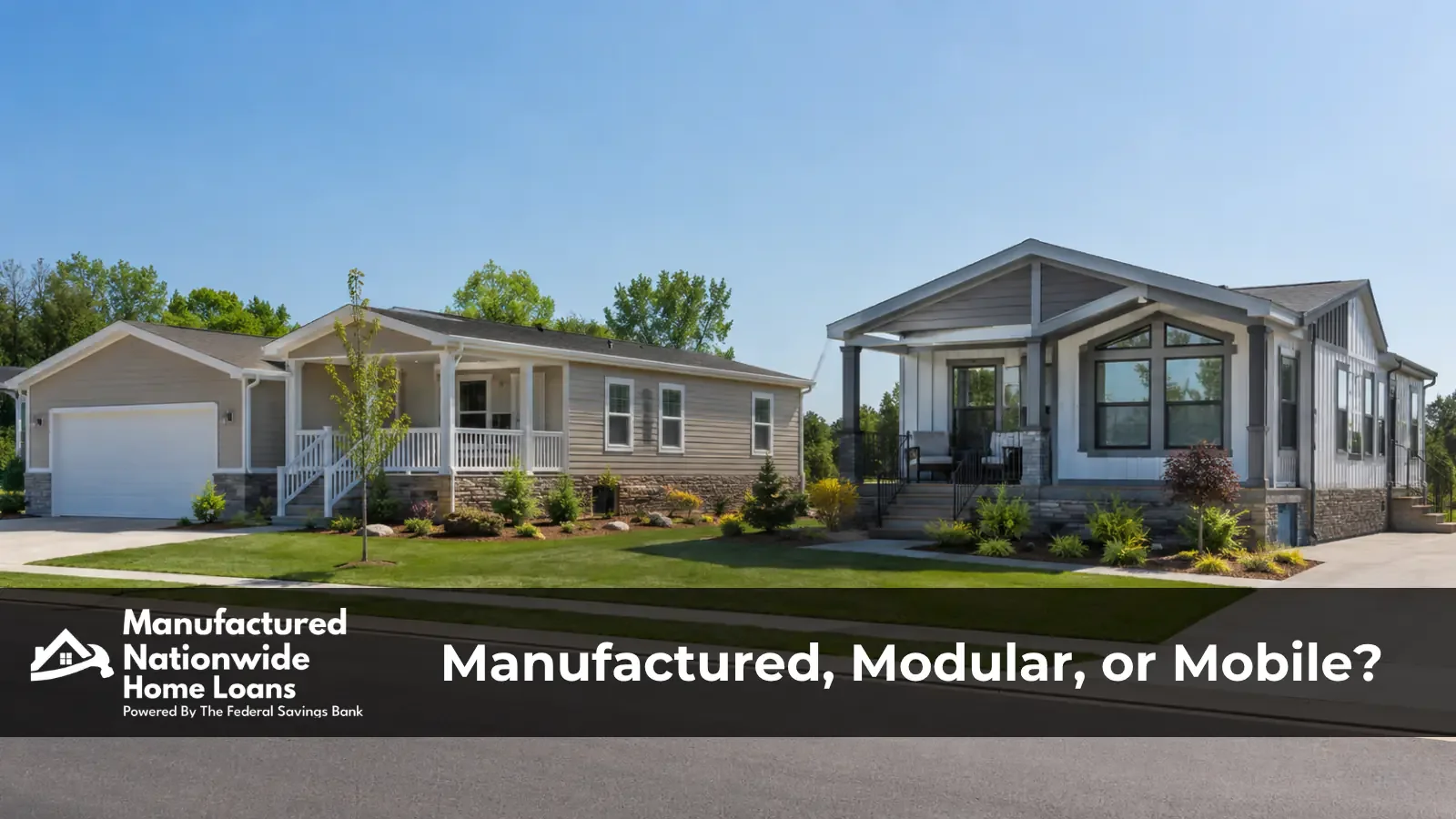
Manufactured vs Modular vs Mobile: Which Home You Have Changes Your Loan
The words get used interchangeably, but for financing they are not the same, and which one you have decides which loans you can use.
What Counts as a Manufactured Home
A manufactured home is a factory-built home constructed after June 15, 1976, the date HUD's building code took effect. Those homes meet federal construction standards and, once affixed to owned land and titled as real property, qualify for FHA, VA, USDA, and conventional mortgages. This is the sweet spot for the programs on this page.
How Modular Homes Are Financed
A modular home is also built in a factory, but it is assembled on a permanent foundation and is generally treated like a site-built home for financing. That means the widest range of programs and the highest loan amounts, up to $10 million on modular through us, and on VA there is no loan limit at all for fully entitled Veterans.
Why a Pre-1976 Mobile Home Is Harder to Finance
A true mobile home built before June 15, 1976 predates the HUD code and is not eligible for most mortgage programs. If that is what you have, financing usually means a chattel or personal loan, which we do not offer. The good news is that most homes people call mobile homes are actually newer manufactured homes that do qualify.
Comparing the Best Loan Programs for a Manufactured Home
| Program | Financing Up To | Credit Guidance | Best For |
|---|---|---|---|
| VA | 100%, no loan limit | 500 case by case, 580 preferred | Veterans, active duty, and eligible surviving spouses who want zero down and no monthly mortgage insurance |
| FHA | 96.5% | 580 with 3.5% down | Buyers who want a low down payment and flexible debt-to-income limits, including lower credit |
| USDA | 100% | 640 standard | Buyers in a qualifying rural area who are not Veterans and want zero down |
| Conventional | Up to 80%, no PMI | Mid-600s and up | Buyers with a larger down payment, a second home, or an investment property |
| Construction | 100% new from dealer | Varies by base program | Building new or placing a new home from a dealer on land you own, in one Hybrid One-Time Close |
The Best VA Loan for a Manufactured Home
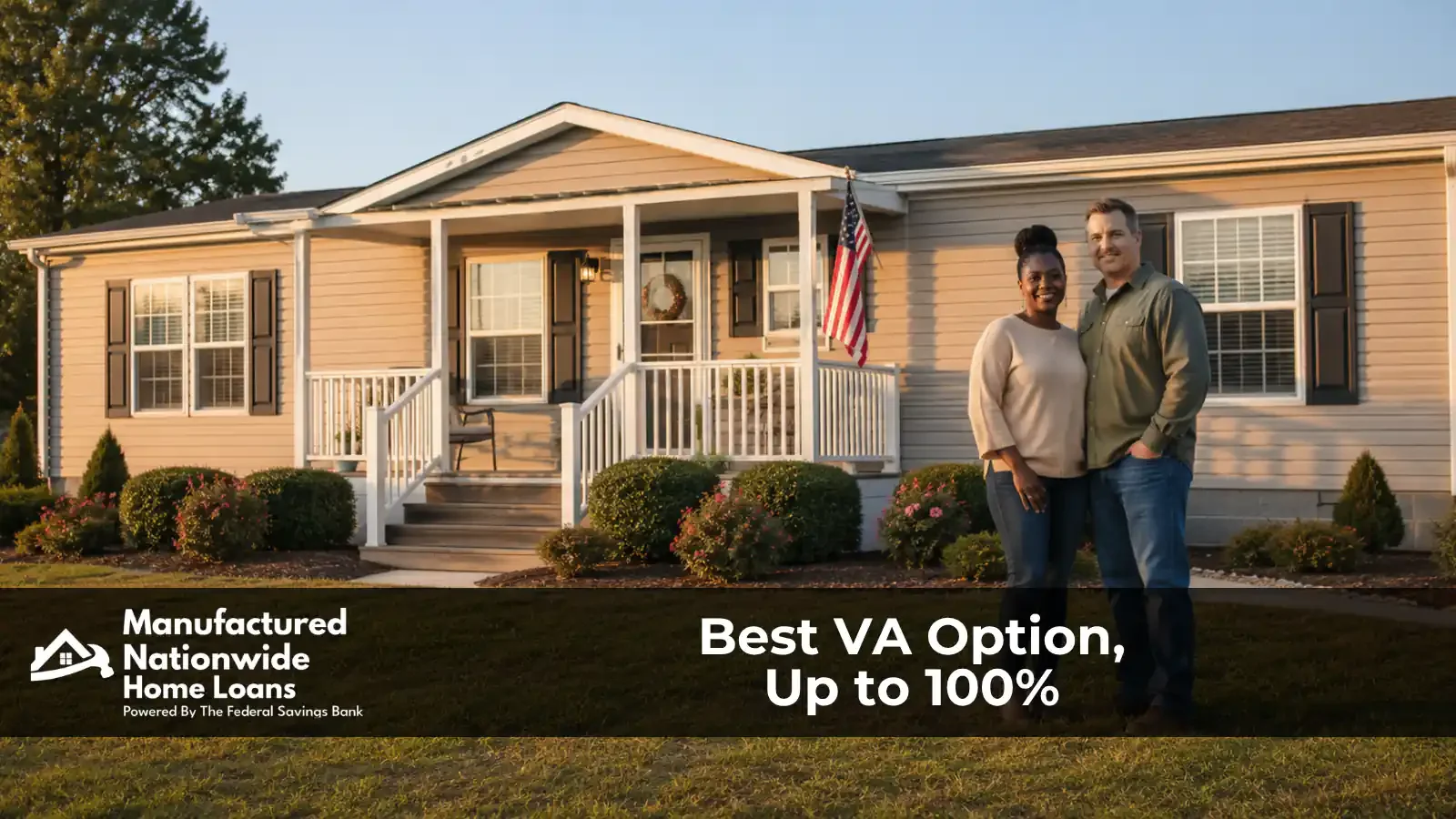
If you are a Veteran, active duty, or an eligible surviving spouse, a VA loan is almost always your best option on a manufactured home, and it is hard for any other program to beat.
VA Purchase at 100% With No Loan Limit
VA lets qualifying Veterans buy at up to 100% with no down payment and no monthly mortgage insurance, which no other program matches. For fully entitled Veterans there is no loan limit, so the price ceiling comes down to what you can afford, not a county cap. You can finance land and a manufactured home together, and you can use your benefit more than once. See the full details on our VA manufactured purchase page.
Refinancing a Manufactured Home With a VA Loan
Already have a VA loan on your home? The VA IRRRL streamline can lower your rate with no appraisal, no income docs, and usually no credit check, even if you owe more than the home is worth. Need cash from your equity instead? A VA cash-out can pull up to 90% of value on a manufactured home, or up to 100% on a modular or site-built home, with Texas capped at 80%.
The Best FHA Loan for a Manufactured Home
FHA is the most popular program on manufactured homes for a reason: it is built for buyers who want a low down payment and who need flexibility on credit and debt.
FHA Purchase at 96.5%
FHA lets you buy at 96.5%, which is 3.5% down, on a manufactured home affixed to owned land. County limits apply, which you can check on our county loan limits page, and the same program covers construction and refinance. Full details are on our FHA manufactured purchase page.
FHA for Lower Credit and Higher Debt-to-Income
FHA generally starts at a 580 score with 3.5% down, and it allows higher debt-to-income limits than conventional or USDA. That combination is why a buyer who does not fit a conventional box can often still qualify comfortably on FHA. If your credit sits below 580, read the lower-credit section below, because our in-house committee reviews those files case by case.
The Best USDA Loan for a Rural Manufactured Home
If you are buying in a qualifying rural area and you are not a Veteran, USDA is often your best path to zero down.
Is Your Property in a USDA-Eligible Area?
USDA offers 100% financing with a monthly insurance cost that is lower than FHA, for properties in eligible rural areas. The trade-offs are a stricter underwriting process, additional foundation reports, and income limits by area, and USDA does not allow cash-out. There is also a pilot program that opens the door to some existing manufactured homes. See the full breakdown on our USDA manufactured page, and ask us whether USDA or FHA fits you better, since the answer depends on your income and the property.
The Best Conventional Option for a Manufactured Home
When Conventional Beats FHA and VA
Conventional financing runs up to 80% with no mortgage insurance, which makes it the best fit when you have a larger down payment. It is also the only path for a second home or an investment property, since FHA, VA, and USDA are for primary residences. If you are putting down 20% or more, conventional often wins on total cost. Start from our loan programs hub while our dedicated conventional page is in the works.
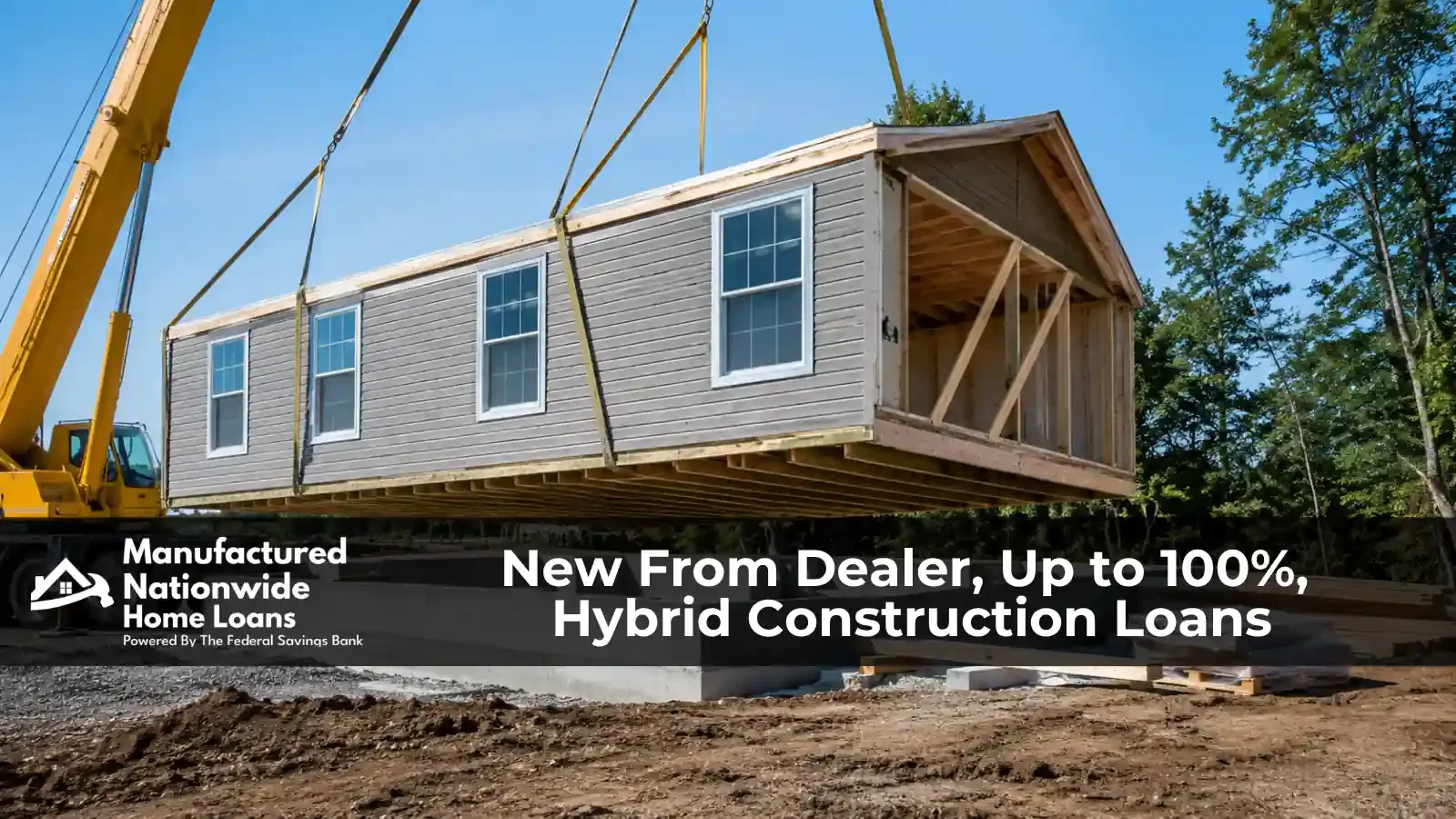
The Best New From Dealer Manufactured Construction Loan
If you are buying a brand-new home from a dealer or building on your own land, our Hybrid One-Time Close construction loan is usually the best structure, and it is one of the places we clearly stand apart. It finances the land and the new home together, and we stay your lender from the first draw to the last.
New From Dealer at Up to 100%
We finance new manufactured and modular homes straight from the dealer, up to 100% for qualifying Veterans, with the land, site prep, foundation, delivery, and setup all rolled in. It is one loan for the finished home on ground you own, not a separate land loan and home loan stitched together. This is the cleanest path when you have picked a new home at a dealer and want it placed on your own lot.
How Our Hybrid One-Time Close Works
You sign one set of closing documents up front. Then, when the home is complete, we do a simple rate modification to move you into your permanent loan, so there is no second closing and no second set of closing costs. What sets it apart is who handles it. We are your lender from start to finish, we manage every construction draw in-house, and we never pass you off to a servicer or broker the loan out the way many lenders do, so the people who approved your loan are the same people seeing it through to the final draw. On modular, treated like a site-built home, loan amounts run up to $10 million. See the full process on our Hybrid One-Time Close construction page.
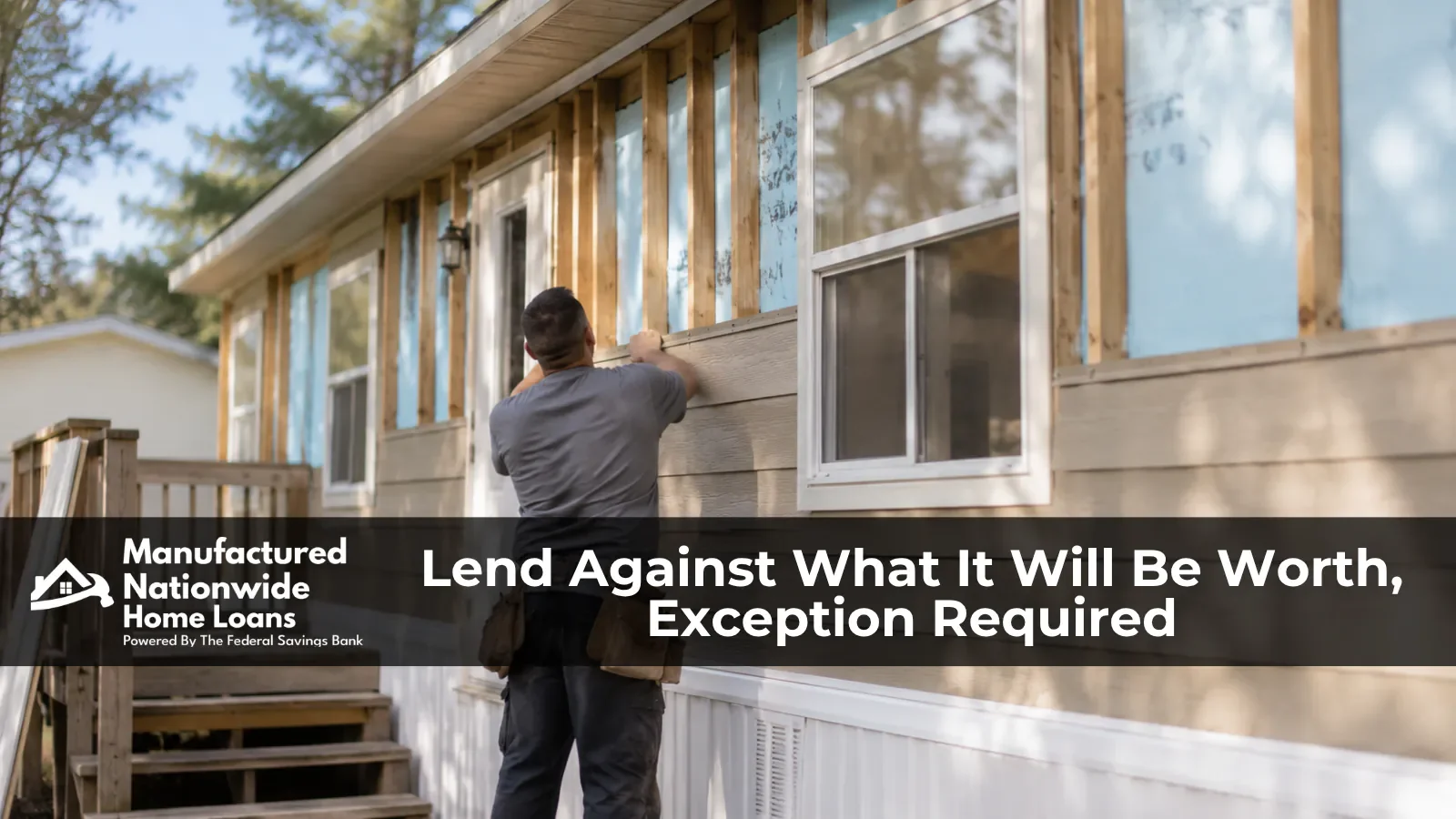
The Best Renovation Loan for a Manufactured Home
A renovation loan lends against what your home will be worth after the improvements are done, not what it is worth today, so you can update the home even at a high loan-to-value. Use it to buy a home that needs work, or to refinance and fund a remodel, an addition, or repairs.
In-House Flexibility on Manufactured Renovations
Some of our renovation financing is kept in-house, which gives us room to work on manufactured homes where standard agency guidelines get rigid. That flexibility matters on factory-built homes, where not every lender will lend against future value. Details are on our manufactured renovation loans page.
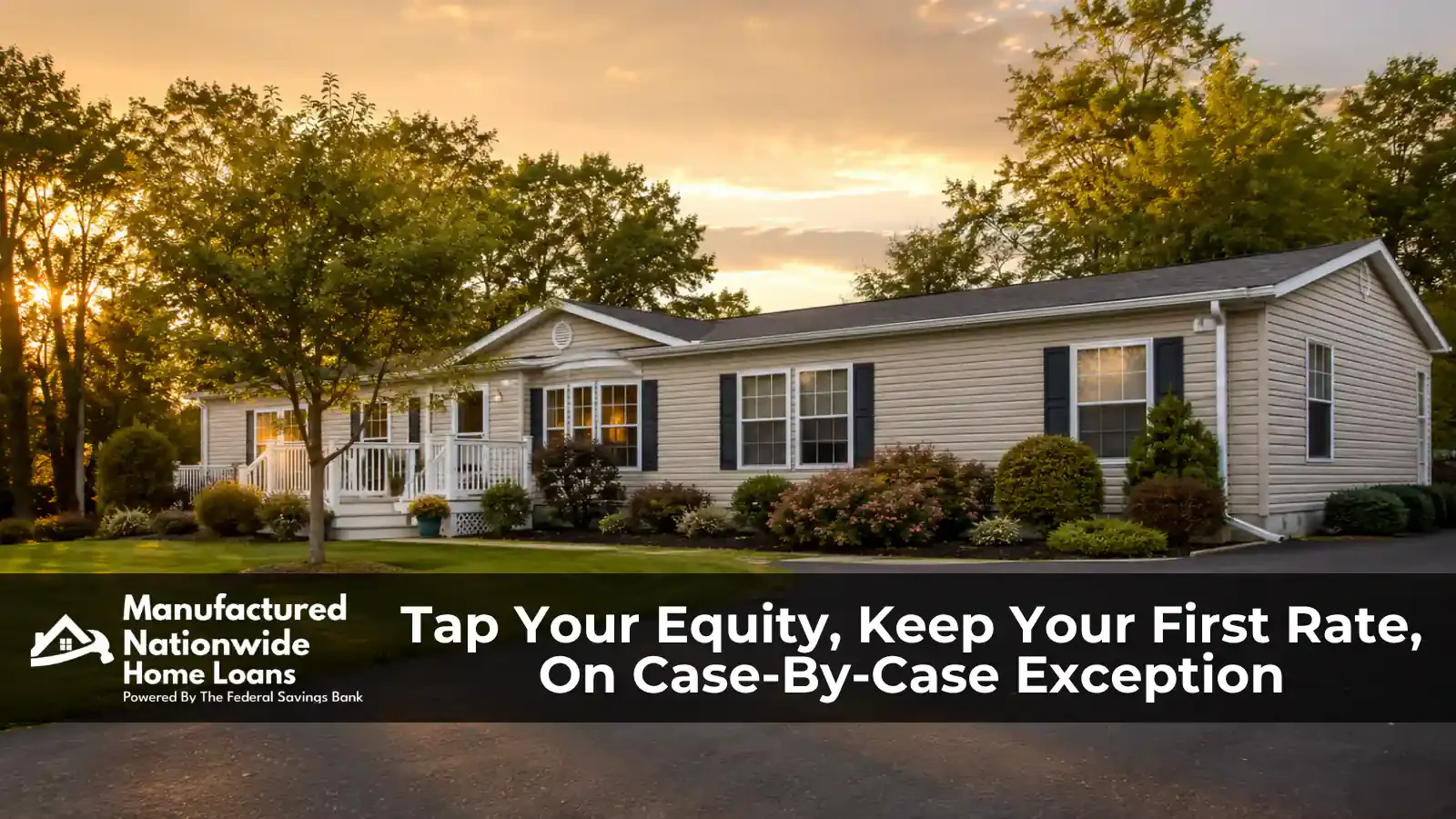
The Best Home Equity, HELOC, and HELOAN on a Manufactured Home
Want cash from your equity without giving up a low first-mortgage rate? A second-lien home equity loan or line of credit leaves your existing mortgage and its rate untouched, which a cash-out refinance cannot do.
Keep Your First Mortgage Rate
A HELOC or a fixed home equity loan sits behind your first mortgage as a second lien, so the rate you locked stays exactly where it is. On manufactured homes these are approved by exception, are for doublewide or larger homes on owned land, and are reviewed case by case, but when they fit they are the cleanest way to tap equity without disturbing your first loan. See our manufactured home equity loans page.

The Best Manufactured Home Loan for Bad or Lower Credit
Lower credit does not automatically rule you out, and the picture is more flexible than most buyers are told. Here is the honest version.
How Our In-House Loan Committee Looks at Credit
There is no such thing as guaranteed approval on a mortgage, and any lender promising it should worry you. What we can do is underwrite in-house, which means our own loan committee weighs the whole file rather than bouncing you off a single score. The VA sets no minimum score on some programs, and while most large lenders add their own overlay, we have approved scores as low as 500 on a case-by-case basis. We prefer 580 and above, and approval always depends on the rest of your file, but a low score alone is not the end of the conversation.
Buying After a Bankruptcy or Past Mortgage Lates
We have real success helping buyers after a bankruptcy, with older mortgage lates, or after being turned down elsewhere, once the rest of the file is strong. Before you apply anywhere, check your credit for errors, because a turn-down for something fixable can set your score back further. If you spot a problem, we work with professionals who can help clean it up before closing. The goal is to fix what is fixable, then find the program that fits.

Best Loan for a Manufactured Home on Land You Own, or a Chattel Loan?
This is the biggest fork in manufactured home financing, and it decides almost everything else. Own the land, or buy it, and you get a real mortgage. Sit in a park or on rented land, and you are usually limited to a chattel loan.
A chattel loan finances the home only, not the ground under it, and it is what you use when the home sits in a park or on land you rent. It can be the right tool in some situations, but it comes with trade-offs a real-property mortgage does not. We finance homes that are permanently affixed to land you own and titled as real estate, so it is worth understanding what you give up on leased land before you choose.
Your lot rent can climb. You own the home, but you still answer to a landlord for the land, and that rent can rise year after year with little you can do about it.
The land can be sold out from under you. If the park or parcel changes hands, a new owner may raise costs, change the rules, or redevelop, and that happens more often than people expect.
You can be forced to move. When the ground is not yours, a sale or a closure can leave you moving a home that is expensive and difficult to relocate.
Costs are harder to control. Between lot rent, fees, and rule changes, a leased-land setup can behave like an HOA with far less protection, and the numbers are not fully in your hands.
Rates and terms are usually worse. Chattel loans tend to carry higher rates and shorter terms than a real-property mortgage, so you often pay more for less time.
Buying or Building on Family Land
Family land is a common situation and it has its own rules. We can finance a home on family land only when it sits on a separate parcel with no other property on it, and when you are on the title to that land. If that describes your setup, you are treated like any other owned-land borrower. If the land is shared or you are not on title, talk to us early, because the path may run through a survey and a parcel split before financing works.
Already on Leased Land or in a Park? Your Path to a Real Mortgage
If you are in a park or on rented land today, we cannot finance your current home, because that needs a chattel loan and we lend on real property only. But that is not a dead end. Most people in this spot have a real path to a mortgage, lower rates, and land they control, and almost nobody walks you through it.
Buying the Land You Already Live On
If the park or landowner is willing to sell you your lot, or a separate parcel, buying the ground under your home can be the single best financial move you make. Once the home is permanently affixed to land you own and titled as real property, it stops being chattel and qualifies for a real mortgage. Ask us how to structure it.
Moving to Owned Land With a New Home
The other path is to buy or already own a parcel and place a new manufactured or modular home on it, financed through a single one-time close construction loan that rolls the land and the home into one loan. You end up with a newer home, a real mortgage, and no landlord over your land. It is more moving parts than a park purchase, but it is often the better long-term answer.
How to Choose the Best Manufactured Home Lender
Once you know your program, the lender matters just as much, because not every bank closes manufactured loans and the wrong one can cost you a rate lock, a closing date, or the home itself.
Money named Manufactured Nationwide Best for Loan Variety among 2026's top mobile home lenders, describing our lineup of loan options as unmatched.
Questions to Ask Any Manufactured Home Lender
Ask these before you commit. Do you actually close manufactured and modular loans, and how many a month? Do you underwrite in-house, or send my file elsewhere? Do you offer FHA, VA, USDA, and conventional, so I am matched to the best fit rather than the one loan you sell? Will I get the same banker from application to closing? Do you lend in all 50 states? We built this business to answer yes to all of those, with direct access to your banker and an in-house loan committee. That is what "best lender" should mean for this kind of home.
How Much Can You Borrow and What It Takes to Qualify
Loan Amounts and Down Payment by Program
Your down payment ranges from nothing to about 20% depending on the program. VA and USDA can go to 100% for qualifying borrowers, FHA reaches 96.5%, and conventional runs up to 80% with no mortgage insurance. Loan amounts go as high as $4.5 million on construction and $10 million on modular, with no loan limit on VA for fully entitled Veterans. Your actual amount comes down to income, credit, the program, and the property. Estimate a payment with our manufactured home loan calculator.
Credit, Debt-to-Income, and Documents
Credit is flexible, as covered above, with approvals as low as 500 case by case and 580 preferred. Your debt-to-income ratio matters as much as your score, and FHA allows higher limits than most programs. Expect to provide income documents, bank statements, and ID, though the exact list depends on the program. The most useful first step is a pre-approval, which sizes all of this up front.

Get Pre-Approved Before You Shop
The most useful move you can make is to get pre-approved before you shop, and certainly before you sign a purchase contract. A pre-approval tells you the price range you actually qualify for, most agents require it, and it carries real weight with sellers who know not every lender closes manufactured loans.
Walking in with a letter from a manufactured home specialist can be the difference between winning a home and losing it. Our pre-approval costs nothing to start and there is no credit pull to check general eligibility. You tell us your situation, we tell you what fits, and only when you decide to move forward does anything touch your credit.
Once you have the right base program, two advantages stack on top that no other lender in this space offers. Start with the extra cash.
Add Up to $50,000 on Top of Any Program
Whichever program you choose, qualified borrowers can add up to *$50,000 in separate, unsecured funds, underwritten in-house alongside your mortgage. It does not touch your down payment, your loan-to-value, or your rate, and it can help you furnish, update, or consolidate debt without a second application somewhere else. No other lender in this space offers it.
Ask about the extra $50,000 when you check your eligibility.
Learn About the Consumer Loan*Qualification for up to $50,000 is for qualified borrowers and can be applied to all loan programs. This is a separate unsecured consumer loan underwritten in-house at the same time as your mortgage. Proceeds cannot be used for a down payment. Contact your banker for applicable rates, terms, and conditions.
The second saves you money at the closing table, whether you are buying or selling.
Save up to 30% on real estate commissions. Buy or sell with a participating brokerage in all 50 states and the savings go straight toward your closing costs.
What the new ROAD to Housing Act Means for Manufactured Buyers
Federal law is changing in a way that matters for anyone buying a manufactured home. For decades, every HUD Code home had to keep a permanent steel chassis underneath it, which limited rooflines and floor plans and was part of why these homes were sometimes treated as personal property instead of real estate.
The 21st Century ROAD to Housing Act removes that chassis requirement, which is expected to lower the cost of a manufactured home and open the door to more traditional financing over time. It is a genuinely positive shift for affordability and value. We broke down what is in the act, and what it means for buyers state by state, in our full ROAD to Housing Act guide.
Frequently Asked Questions
What is the best loan for a manufactured home?
There is no single best loan. The best one depends on your situation. Veterans usually do best with a VA loan at up to 100% with no mortgage insurance. Buyers wanting a low down payment fit FHA at 96.5%. Rural buyers who are not Veterans often fit USDA at 100%, and buyers with a larger down payment or a second home usually prefer conventional. All four are available on a home affixed to land you own.
Can I get a mortgage on a manufactured home, or do I need a chattel loan?
If the home is built after June 15, 1976, permanently affixed to a foundation on land you own, and titled as real property, it qualifies for a regular mortgage with FHA, VA, USDA, or conventional financing. You only need a chattel loan when the home sits in a park or on land you rent. We finance real-property homes, not chattel.
What credit score do I need for a manufactured home loan?
It varies by program. FHA generally starts at 580 with 3.5% down, and USDA is typically 640. On VA loans, the VA sets no minimum on some programs, and our in-house loan committee has approved scores as low as 500 on a case-by-case basis, though we prefer 580 and above. No mortgage is ever guaranteed.
How much can I borrow for a manufactured home?
Loan amounts run up to $4.5 million on construction and up to $10 million on modular, with no loan limit on VA for fully entitled Veterans. Your actual amount depends on income, credit, the program, and the property. County limits apply to FHA and conventional.
What is the difference between a manufactured, modular, and mobile home for a loan?
A manufactured home is factory-built after June 15, 1976 and qualifies for standard mortgages once on owned land. A modular home is assembled on a foundation and financed much like a site-built home. A mobile home built before June 15, 1976 predates the HUD code and usually needs a chattel or personal loan, which we do not offer.
Do you finance homes in a mobile home park or on leased land?
No. We finance homes permanently affixed to land you own and titled as real property. If you are in a park or on rented land, we can help you find a path to owning the ground so your home qualifies for a real mortgage.
Can I get a manufactured home loan with bad credit?
Possibly. There is no guaranteed approval, but because we underwrite in-house, our loan committee weighs your whole file and has approved scores as low as 500 on a case-by-case basis. We prefer 580 and above, and we have helped buyers after bankruptcy or past mortgage lates when the rest of the file is strong.
Should I get pre-approved before I shop?
Yes. A pre-approval tells you your real price range, most agents require it, and it carries weight with sellers. Ours starts with no credit pull.
Ready to find your program? Check your eligibility in a few minutes, with no credit pull and no obligation.
Explore Every Manufactured Loan Program
Manufactured Renovation Loans | Manufactured Home Equity Loans
Specialty programs most lenders do not offer: Down Payment Assistance up to 101.5% | ITIN Home Loans | Self-Employed and 1099 Loans